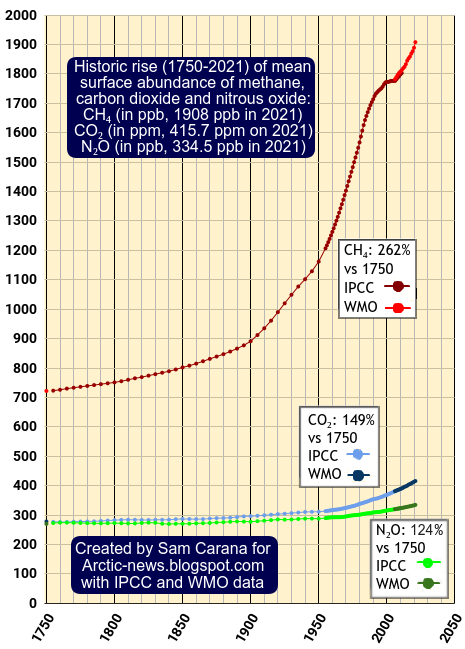
could be crossed even earlier than in 2026. Let's re-evaluate these dangers.
. Destabilization of sediments at the seafloor of the Arctic Ocean could cause a large abrupt burst of methane to enter the atmosphere over the Arctic Ocean. A doubling of the mean methane level could push up the mean methane level to twice as much, to 792.4 ppm CO₂e, which is only 407.6 ppm CO₂ away from the 1200 ppm CO₂e
that on its own could push up the temperature by some 8°C globally. This gap of 407.6 ppm CO₂ could be more than covered by the current carbon dioxide level. The September 2022 CO₂ level at Mauna Loa was higher than that, i.e. 415.96 ppm. Since the CO₂ level at Mauna Loa in September typically is at its lowest point for the year, this implies that a large abrupt burst of methane could cause the the clouds tipping point to be instantly crossed due to methane and CO₂ alone.
Note that there are additional forcers, such as CFCs, while there are also further events and developments that could additionally speed up the temperature rise, as further discussed below. The scary situation therefore is that the clouds tipping point could be instantly crossed with a burst of methane that is far smaller in size than the methane already in the atmosphere. Such a burst of methane could be released at any time, as discussed in earlier posts such as
this one.
That's not even the worst-case scenario. In the above calculation, global mean methane levels are used. However, there is a possibility that low-lying clouds could at first break up and vanish abruptly at one specific point, due to a high methane peak, and that this could lead to break-up of neighboring clouds, propagating break-up across the globe and thus pushing up the temperature rise virtually instantly by some 8°C globally.
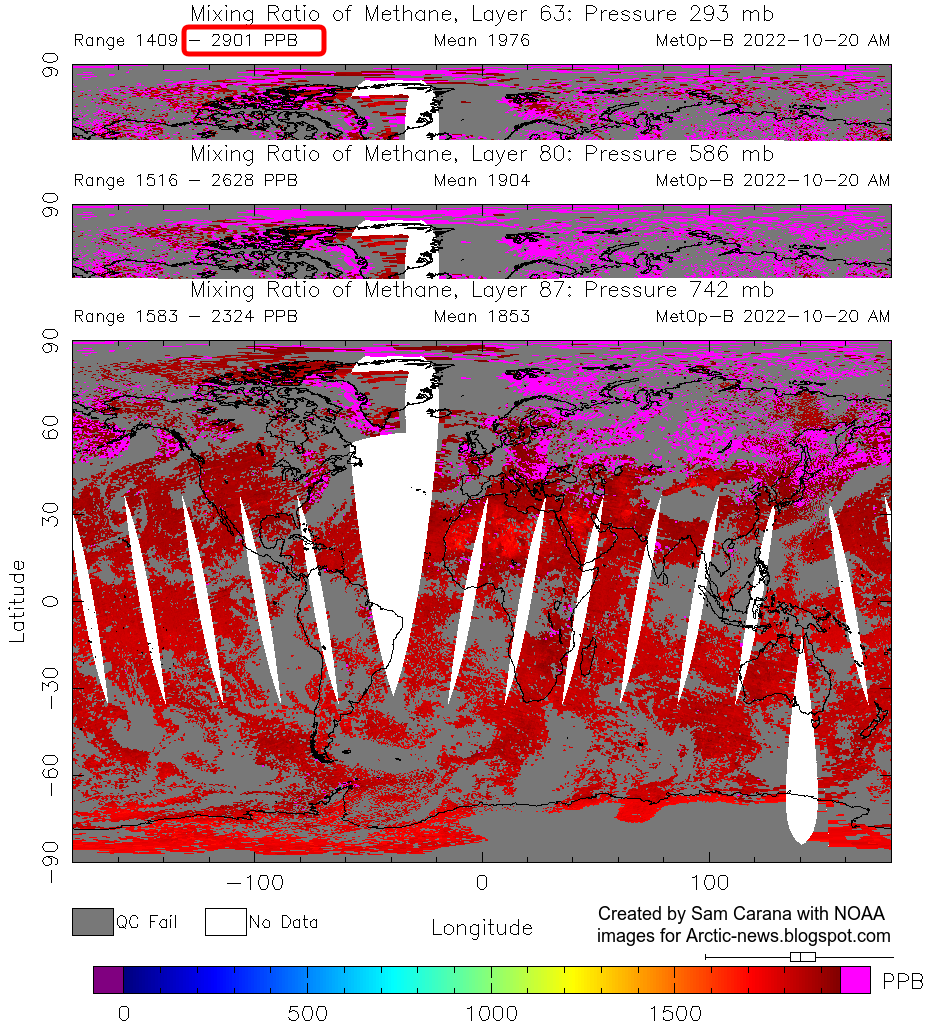
The MetOp satellite recorded a peak methane level of 3644 ppb and a mean level of 1944 ppb at 367 mb on November 21, 2021, pm, as discussed in an
earlier post. This 3644 ppb translates into 728.8 ppm CO₂e, again at a 1-year GWP of 200. This is 471.2 ppm CO₂e away from the clouds tipping point and that 471.2 ppm CO₂e could be covered by the carbon dioxide, nitrous oxide and CFCs currently in the atmosphere.
How high could the temperature rise be by 2026?
There are a number of scenarios that could cause the clouds tipping point to be crossed soon, e.g. if the rise in methane kept following a trend as depicted in the image below, showing WMO 2015-2021 global annual surface mean methane abundance, with a trend added.
 |
| [ click on images to enlarge ] |
The trend points at a potential mean global abundance of methane of more than 700 ppm CO₂e by the end of 2026, implying that when including further forcers the clouds tipping point could be crossed in 2026. Furthermore, the trend points at 1200 ppm CO₂e getting crossed in 2028 due to the forcing of methane alone.
Even without such an increase in methane, a huge temperature rise could eventuate by 2026, first of all due to a cataclysmic alignment of El Niño and sunspots.
We are currently in the depths of a persistent La Niña, as illustrated by the image on the right, adapted from
NOAA, and this suppresses the temperature rise at the moment.
The next El Niño is already overdue, so the peak of the next El Niño may well coincide with a peak in sunspots which look set to reach a higher than expected maximum impact around July 2025. The rise in sunspots from May 2020 to July 2025 could make a difference of some 0.15°C, concluded an
earlier post.
Moving from the bottom of the current La Niña to the peak of a strong El Niño could make a difference of more than half a degree Celsius, as indicated by the image below, adapted from
NOAA.
Therefore, the rise due to the combined impact of El Niño and sunspots could be 0.65°C by 2025. When adding this to the temperature rise that has already occurred and that, when measured from
pre-industrial could be as high as 2.29°C, the total land-ocean global temperature rise could be as high as 2.94°C by 2025, while the rise on land on the Northern Hemisphere could peak at more than 3°C above pre-industrial, noting that when there was a strong El Niño in February 2016, the land-only monthly anomaly from 1880-1920 was 2.95°C, as illustrated by the image below.
Such a huge rise could cause heatwaves and droughts that could result in a huge peak in power demand, as everyone switches on their air conditioners, while at the same time rivers could either dry up or their water could become too hot to cool power plants. This could bring the grid down, which would mean that coal-fired power plants would stop emitting sulfates.
This could mean that equipment and appliances that need electricity such as heaters and air conditioners could stop working. Electric pumps could stop working, so there may no longer be water coming out of taps. The internet could stop working where routers require power from the grid.
Furthermore, the heat could cause asphalt and tarmac to melt and rail tracks to buckle, while airports could be closed, not only because the surface of the runway could get too hot, but also because the air could become too thin for planes to take off due to the heat.
In short, traffic, transport and industrial activities such as smelting, which are emitting a lot of sulfates as well at the moment, could grind to a halt at many places on the Northern Hemisphere. The result would be a large reduction in aerosols that are currently masking the full wrath of global warming (mainly sulfates).
How much difference could it make? The IPCC in AR6 estimates the aerosol ERF to be −1.3 W m⁻², adding that there has been an increase in the estimated magnitude of the total aerosol ERF relative to AR5. In AR6, the IPCC estimate for liquid water path (LWP, i.e., the vertically integrated cloud water) adjustment is 0.2 W m⁻², but a
recent analysis found a forcing from LWP adjustment of −0.76 W m⁻², which would mean that the IPCC estimate of −1.3 W m⁻² should be changed to -2.26 W m⁻². When using a sensitivity of ¾°C per W m⁻², this translates into an impact of -1.695°C. Since the IPCC's total for aerosols includes a net positive impact for warming aerosols such as black carbon, the impact of cooling aerosols only (without warming aerosols) will be even more negative.
This supports the
2016 analysis that warned that by 2026 there could be a 1.9°C temperature rise due to a decrease in cooling aerosols, while there could be an additional 0.6°C temperature rise due to an increase in warming aerosols and gases as a result of more biomass and waste burning and forest fires by 2026.
So, together with the upcoming El Niño and a peak in sunspots, that could result in a total rise by 2026 of 5.44°C above pre-industrial. There's more to come! Additionally, the 2016 analysis warned about further rises in temperature due to loss of Arctic sea ice and permafrost, and associated changes, as well as further rises due to gases, concluding that there could be a temperature rise by 2026 of more than 10°C compared to pre-industrial.
With a temperature rise of more than 10°C by 2026, the clouds tipping point will also be crossed, which would result in a total rise of more than 18°C by 2026. Keep in mind that humans are likely to go extinct with a rise of 3°C, as illustrated by the image below, from an analysis discussed in an
earlier post.
The situation is dire and the right thing to do now is to help avoid or delay the worst from happening, through action as described in the
Climate Plan.
Links
• WMO - More bad news for the planet: greenhouse gas levels hit new highs
• WMO - Greenhouse Gas Bulletin